Chase Pay Monthly
Making travel dreams affordable
5 min read

Context
Chase customers want to travel. Most can't afford to pay upfront.
Chase's Alternative Lending team identified a $1.2T opportunity in travel BNPL by 2030, and a gap in the market: no premium financial product designed specifically for travel financing within an existing banking ecosystem.
Strategic Opportunity
Expand lending beyond traditional card products.
Design Challenge
Communicate interest, fees, and a fluctuating final payment without overwhelming users.
Our Constraint
Chase customers expect premium, trustworthy financial experiences.
Problem
High travel costs force a false choice.
High travel costs force customers into a false choice: delay the trip, compromise the experience, pay in full, or redeem points they may have been saving for something else. Traditional payment options don't meet customers where they are financially.
The core challenge: integrate a contextual BNPL solution into Chase Travel while making a complex, unfamiliar product feel clear, trustworthy, and manageable. Unlike typical BNPL offerings, Chase Pay Monthly carried interest, fees, and a fluctuating final payment, so transparency had to be built into every step without overwhelming users.
Discovery
Customers don't think in totals. They think in thresholds.
Through 1:1 concept testing across nine installment variations, one insight reframed the entire product direction.
Customers evaluate financing through a personal "debt comfort zone," a mental threshold that shapes their willingness to adopt installments, sensitivity to interest, and expectations for transparency.
This single finding drove our product definition, audience targeting, and every information hierarchy decision that followed.

Solution
Pay Monthly wins when control matters more than rewards.
Debit-heavy users
Prioritize predictable monthly payments over rewards earning.
Financial planners
Want to know exactly what they owe and when.
Reluctant travelers
High travel intent, blocked by upfront cost.
The Task
Clarifying the loan management experience.
My teammate Susie and I owned the loan management experience, specifically the Details screen, the central hub where customers would track, understand, and act on their loan.
Interest-bearing
Unlike most BNPL, this loan accrued interest.
Fee-bearing
Late and processing fees added complexity.
Fluctuating final payment
The final payment amount could change, and customers needed to understand why.
Research
Three rounds narrowed the loan management experience.
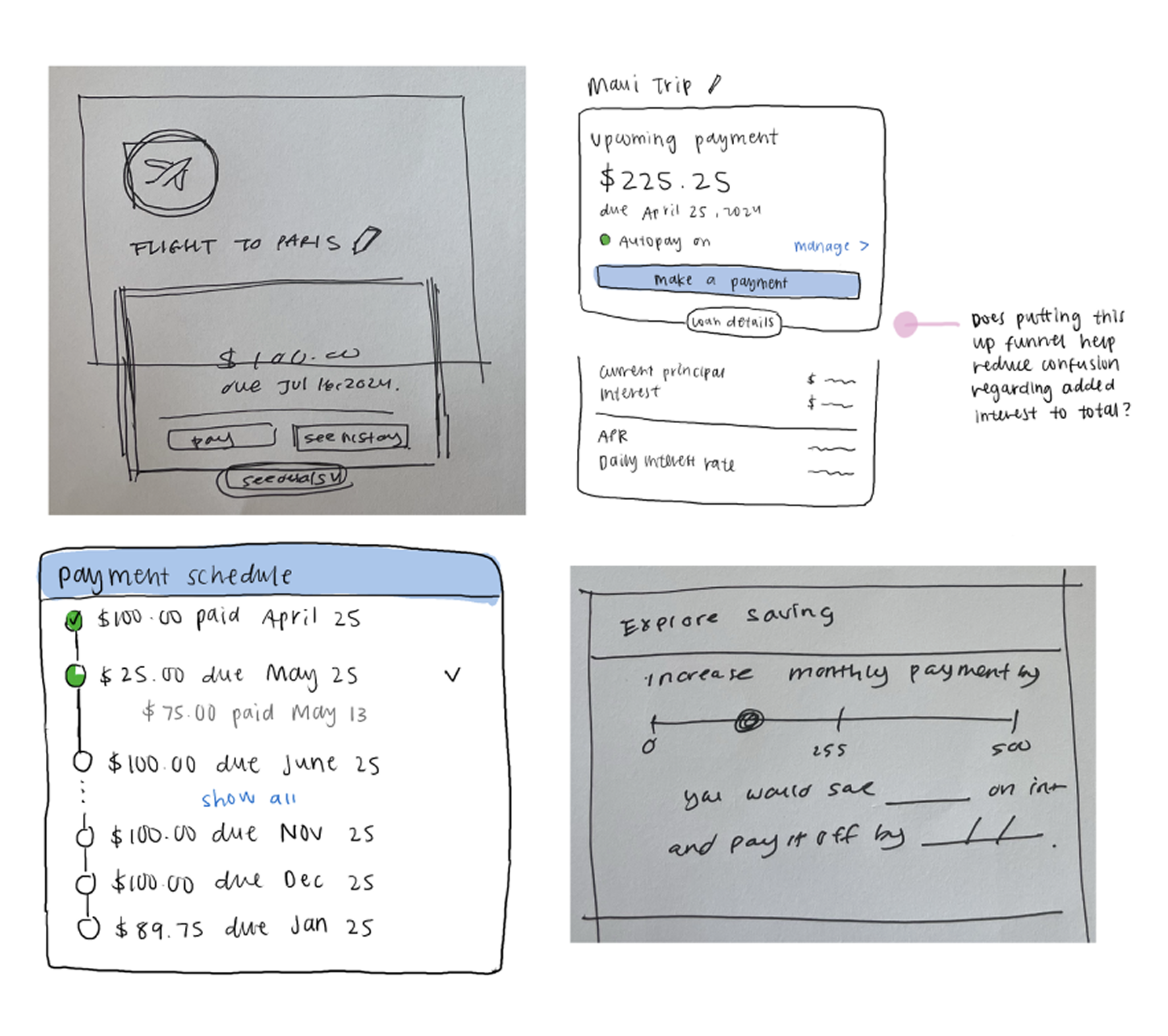
Each round tested a different layer of the product: what information customers expected, how much detail they needed, and whether the final design held up across real repayment scenarios.
Round 1
Concept Testing
What do customers expect from a loan details page?
Round 2
A/B Testing
Which design approach best supports comprehension and payment management?
Round 3
Usability Testing
Does the final design hold up under real edge-case behavior?
Round 1
Customers don't want more data. They want the right data.
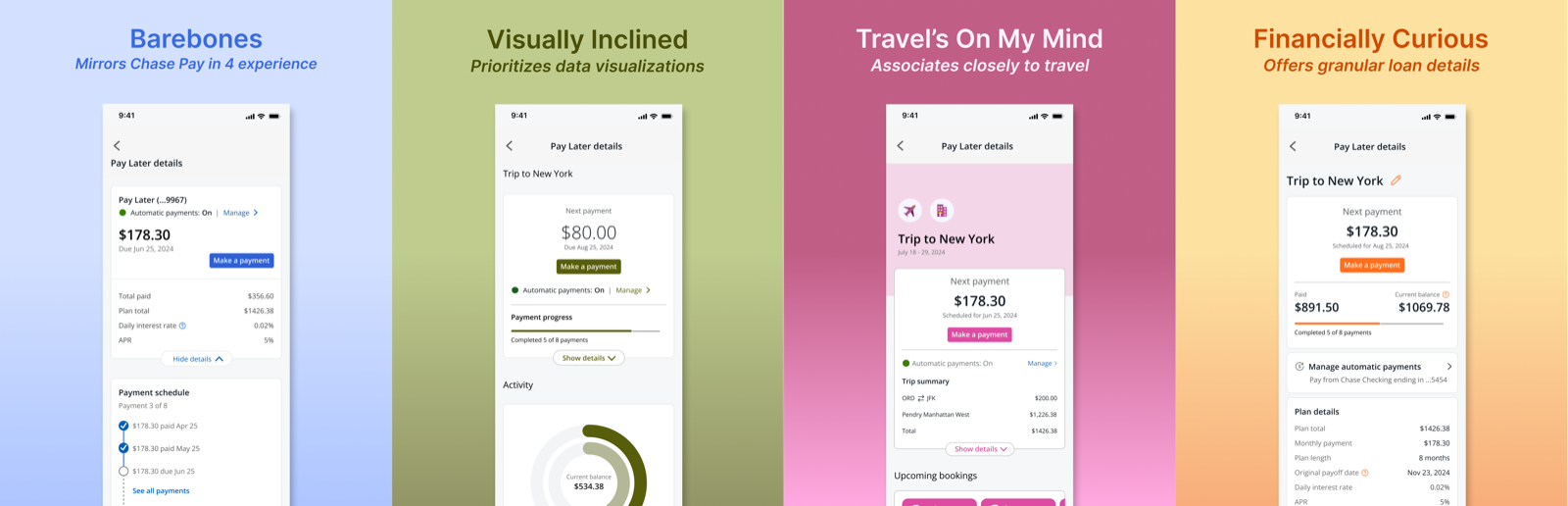
We benchmarked BNPL, auto loan, and mortgage experiences to understand what customers expected from a loan details page, then tested four concept directions to learn which details helped them feel oriented versus overwhelmed.
Travel context matters
Showing trip details reinforced the loan's purpose and built excitement.
Numbers overwhelm
Customers didn't need a principal-to-interest breakdown; total payment amount was enough.
Dates and amounts first
Due dates and payment amounts were non-negotiable; source account visibility built trust.
Data visualizations added cognitive load without improving comprehension. We cut them entirely.
Round 2
When real numbers made money feel real, detail built confidence.
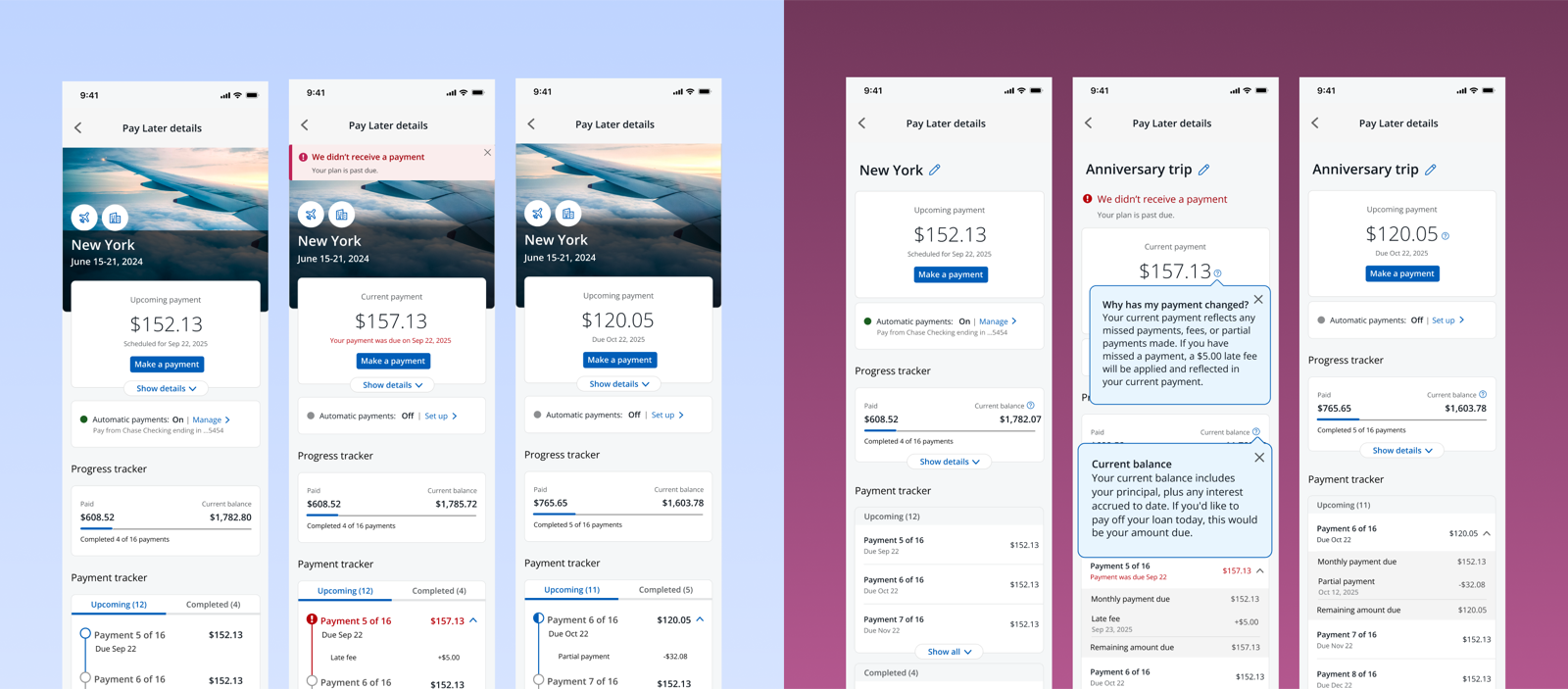
We A/B tested two versions across on-time, late, and partial payment scenarios using realistic balances, due dates, and repayment amounts. Version A emphasized a simpler tracker with stronger visual cues, while Version B gave customers more detailed payment context and support tools.
Version A
Version B
Emphasis
Visual cues and iconography
Content depth and customization
Tracker style
"Subway style" — next and last payments foregrounded
Completed payments foregrounded
Extras
Completed payments hidden
Tooltips and interest calculator included
Version A
Visual cues and iconography
"Subway style" — next and last payments foregrounded
Completed payments hidden
Version B
Content depth and customization
Completed payments foregrounded
Tooltips and interest calculator included
The image was the surprise
Trip destination and dates were the most essential header content, but the photo was what created genuine delight.
Ambiguity calls for boldness
In moments like a missed payment, customers wanted bolder, more detailed UI, not simplified messaging.
Tooltips earned their place
The interest calculator helped customers understand how payments compound, and they wanted it.
Real repayment scenarios showed that customers wanted the interface to tell them what to do next. When they were late, the page needed to help them resolve it. When they were on track, it needed to stay quiet.
Round 3
Comprehension held. Consequences still needed surfacing.
We ran 30 unmoderated usability sessions across four customer scenarios — net-new, late payment, overpayment, and completed — to see if the design held up under real financial decision-making, not just comprehension.
Net-New
97% found the payment schedule easy to navigate — but 9 of 30 confused remaining balance with total payoff
Late Payment
The red alert banner drew attention immediately — but 10 of 30 missed their final payment change
Overpayment
Payments were easy to make — but only 21 of 30 connected an overpayment to its effect on their final payment
Completed
Nearly everyone was delighted by the completion moment — though the completed state still surfaced now-irrelevant content
Across all four scenarios, base comprehension was strong — but the design still needed to proactively surface financial consequences, rather than waiting for customers to go looking for them.
Delivery
Every module answered a customer question.
The final Details page translated the research into a single source of truth for managing a Chase Pay Monthly loan. Instead of walking customers through every possible detail, the page was organized around the questions they were most likely to ask during repayment.
Am I in the right place?
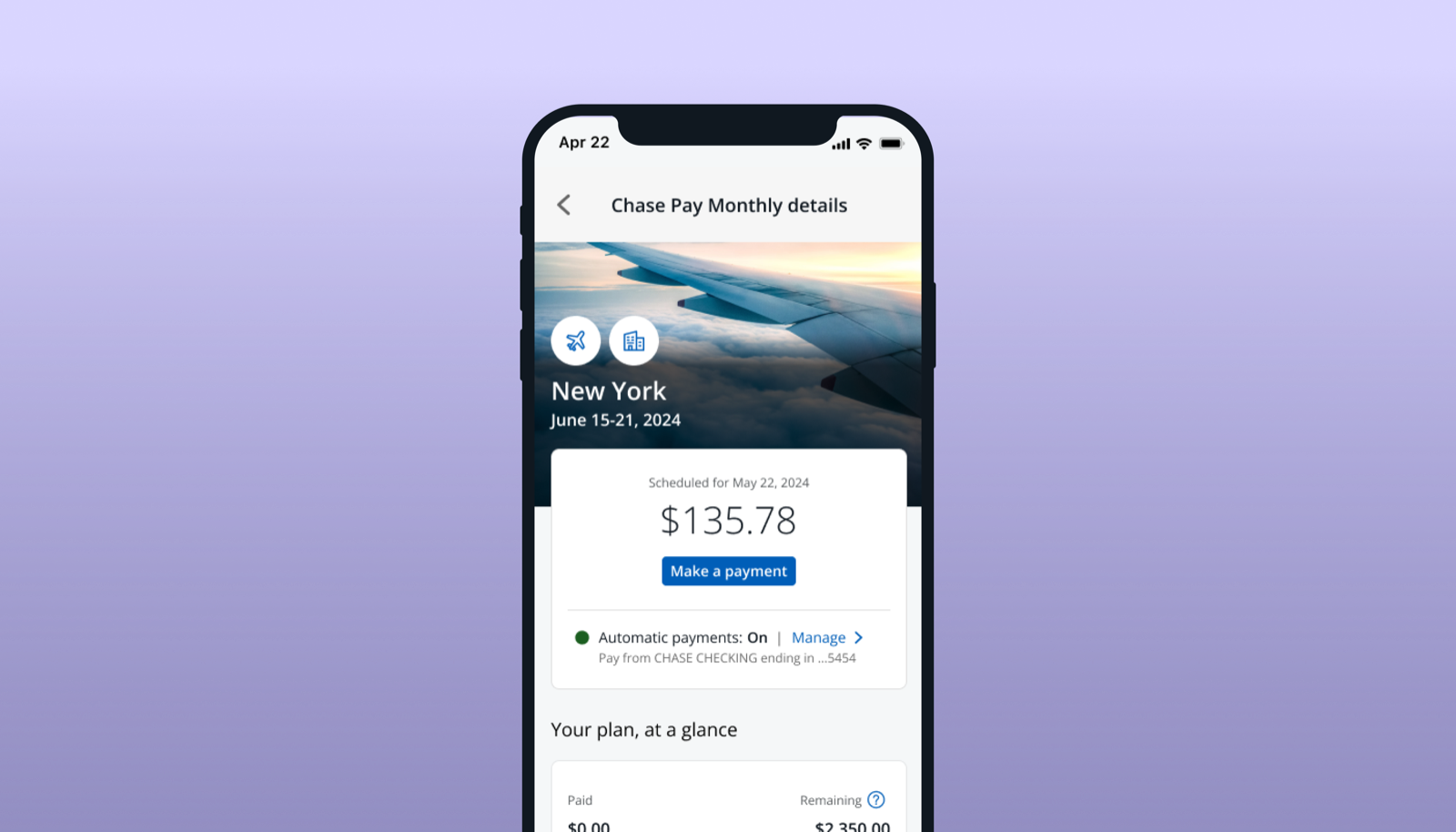
The ability to customize the plan name, paired with the splash image, helped customers recognize which loan they were managing while building excitement for their trip.

What do I owe next?
The payment tile made the amount due, due date, and primary action impossible to miss, giving customers a clear path to stay on track.

Where am I in the loan?
The progress bar and payment schedule worked together to show customers how far they were into their loan.

What changed?
Recent activity and statement access gave customers a record of what happened across payments, including interest changes, late fees, and past transactions.

Learnings
A complex product needed a simple reading order.
Because Chase Pay Monthly was still pre-launch, the goal was not to claim outcomes. The work was about translating research into a focused Details page proposal that made the loan easier to identify, understand, and manage.
Lead with the next decision
The most important information was what customers owed, when it was due, and what action kept them on track.
Make the loan recognizable
Trip context, imagery, and naming helped customers connect the loan back to the purchase they cared about.
Layer the complexity
Progress, schedule, and activity details gave customers transparency without forcing every piece of loan math upfront.
The proposal made a complex financial product feel understandable, transparent, and manageable without asking customers to decode the loan on their own.